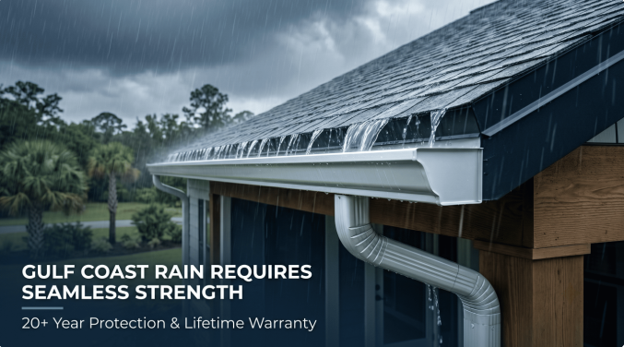

Rain chains are decorative. Downspouts are workhorses. Buried drainage removes the problem from sight entirely. Each one handles roof runoff differently, and on the Gulf Coast, where storms deliver intense, concentrated rainfall rather than gradual precipitation, the choice you make determines whether your foundation stays dry or quietly accumulates damage over time.
Key Takeaways
- Rain chains guide water through surface tension and work in moderate rainfall climates, but they lose containment when Gulf Coast storm volumes exceed what surface tension can manage
- Traditional downspouts handle high-volume runoff efficiently because the enclosed pipe keeps water moving regardless of flow rate
- The discharge point matters as much as the pipe itself, and this is where most drainage failures actually originate
- Buried drainage solves problems that adjusting a downspout elbow can't fix, specifically when lot grading or soil conditions prevent surface water from moving away from the structure
- Collection and discharge must be planned as a single system, not two separate decisions
Why Does the Discharge Point Matter More Than the Pipe?
Most homeowners think hardest about the gutter itself. The downspout is an afterthought. Everything past the downspout barely gets a thought at all.
That's the wrong order of priorities.
Damage doesn't happen at the gutter. It happens at the discharge point, or more accurately, because no one planned one. A gutter that catches every drop of roof runoff and deposits it eighteen inches from your foundation has completed half the job and created the entire problem. The collection is visible. Discharge is where water quietly works against your structure.
Your roof sheds water across its full surface during a hard storm. That water converges at the gutters, travels to the downspouts, and exits somewhere. If that somewhere is tight against the slab, in a low spot that won't drain, or through a rain chain flinging water onto already-saturated soil, the outcome is the same regardless of what caused it: water following the path of least resistance toward your home.
A well-designed drainage system traces that path all the way to where water actually leaves the property, not just where it leaves the fascia board.
What Are Rain Chains Actually Good For?
A rain chain replaces a closed downspout with linked cups or open loops that guide water downward through surface tension and gravity. The design originates in Japanese architecture, where moderate, gradual rainfall and specific building traditions made them genuinely practical alongside being beautiful.
In the right conditions, they still earn their place. They perform well when rainfall is gradual rather than sudden and intense, when the chain terminates into a properly sized catch basin or drainage bed, when the feeding gutter is correctly pitched and sized for the actual roof area, and when appearance is a priority and the property owner accepts some splash radius at the base.
The problem on the Gulf Coast isn't product quality. It's volume. When an intense storm moves through, a rain chain doesn't enclose the water. It guides through surface tension, which works until the flow rate exceeds what that surface tension can manage. At that point, water leaves the chain in an arc. That arc lands wherever gravity sends it. If the soil is already saturated from the first wave of the storm, some of that arc is heading toward your house.
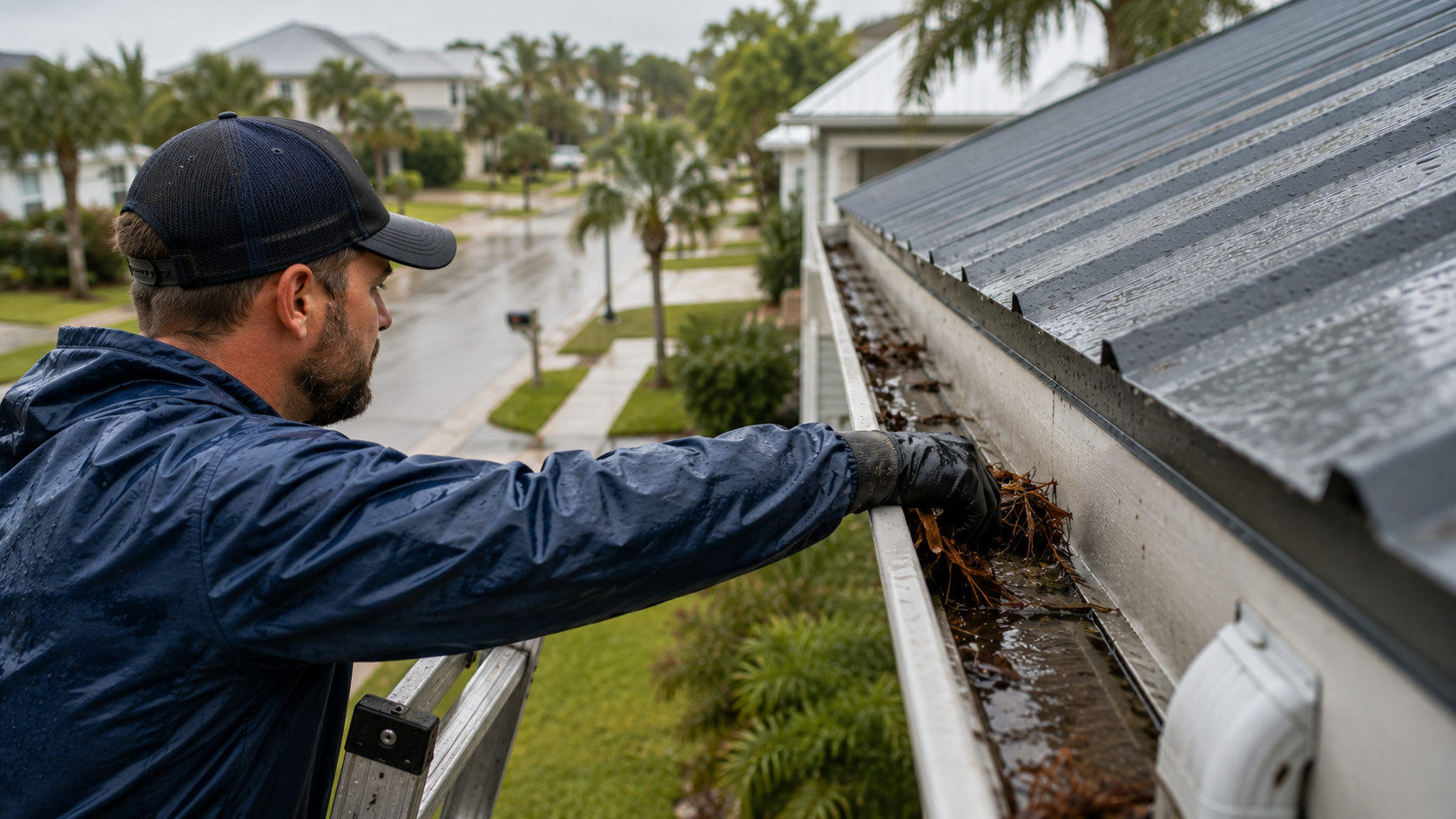
Rain chains also collect debris over time and need regular clearing. That matters in areas with heavy tree canopy, which describes large portions of Pensacola, Gulf Breeze, and Navarre where seasonal leaf load is a real maintenance factor.
How Do Traditional Downspouts Compare?
Downspouts aren't glamorous. They're enclosed vertical pipes that move water from the gutter to ground level and discharge it through an elbow directed away from the structure. They work because the enclosed design keeps water in the pipe regardless of how fast it's moving. There's no surface tension limit. The pipe either handles the volume or it doesn't, and the calculation for correct sizing accounts for roof area, pitch, and expected flow.
A properly installed downspout on a seamless gutter system handles high-volume rainfall without splash loss, directs water to a predictable outlet, and connects to underground drainage when the lot calls for it.
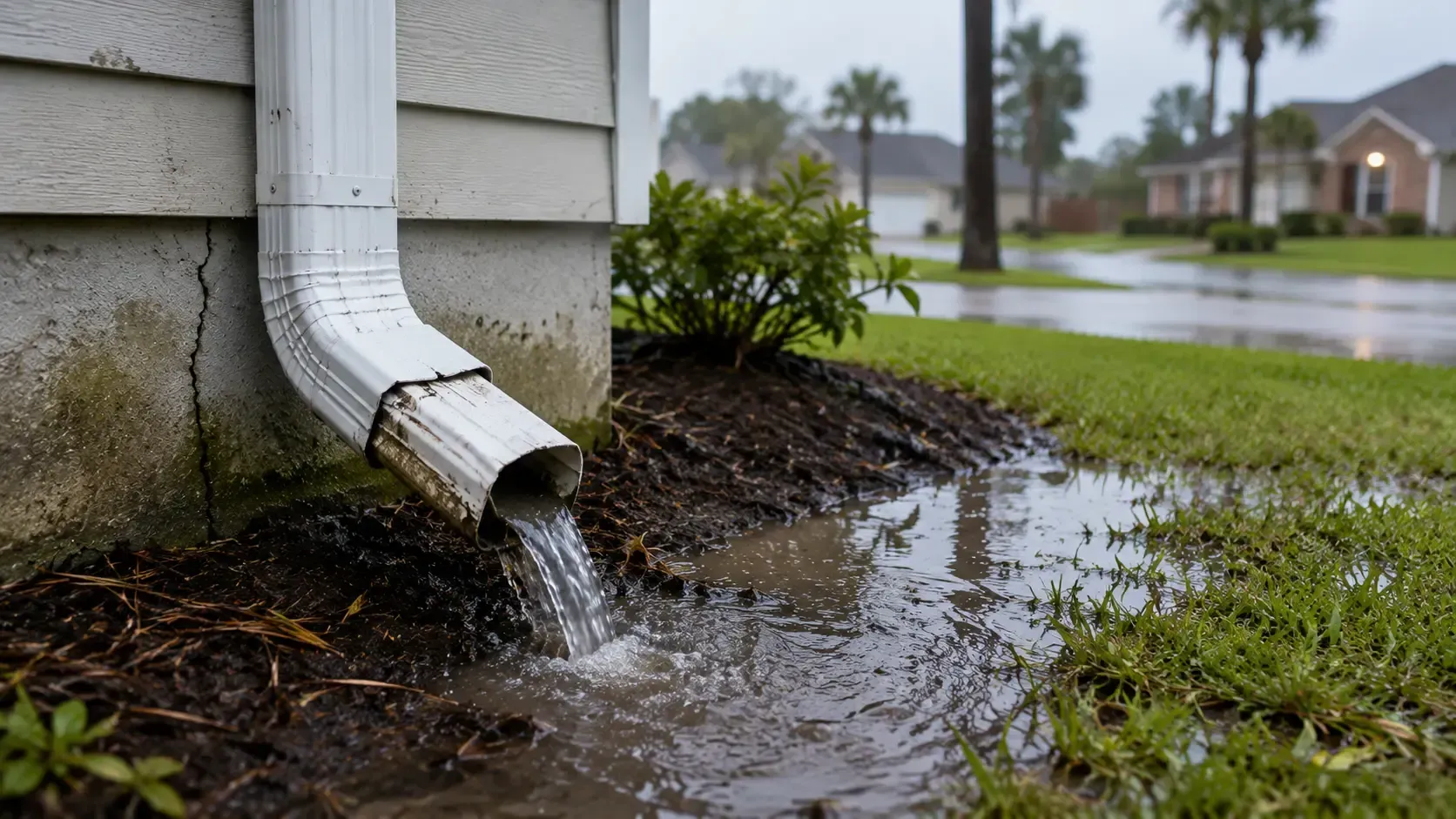
The limitation is entirely about what happens at the bottom. A downspout that terminates at grade level close to the foundation is still a problem even though the pipe itself performed exactly as designed. The water exits and goes where gravity sends it. If that direction is toward the slab or under a crawlspace, the discharge plan failed, not the downspout.
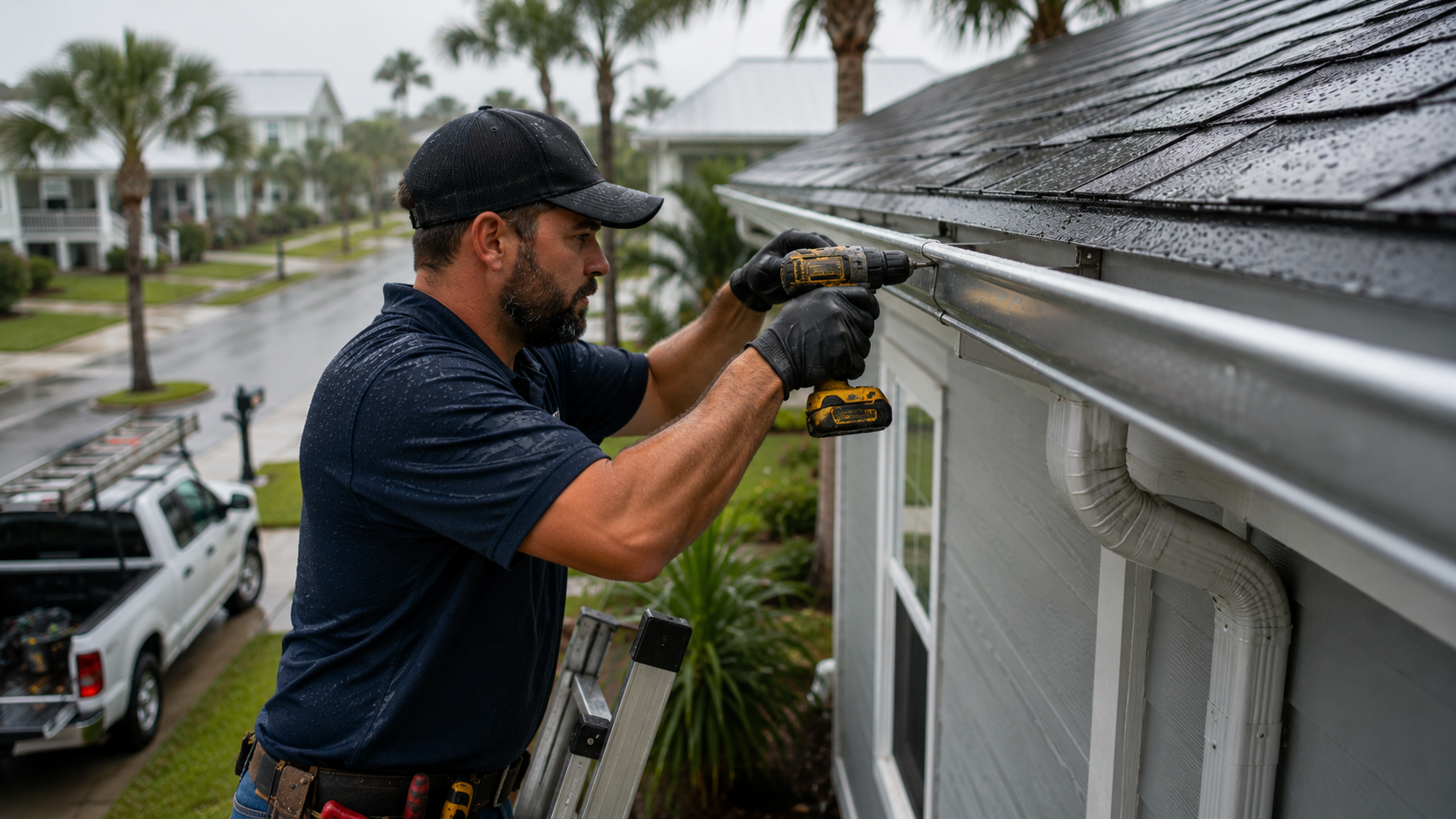
This is the most common failure in DIY gutter repairs. The downspout gets replaced or reattached. The elbow still points toward the house. The next rain event picks up right where the last one left off. If you're evaluating gutter repair or a full replacement, the discharge point deserves as much scrutiny as the gutter profile. They're part of the same system, and fixing one without addressing the other just moves the problem downstream.
When Does Buried Drainage Make Sense?
Buried drainage removes surface water from the equation entirely. Rather than managing runoff at ground level, it captures and redirects water below grade so that it exits the property or disperses into the soil away from the structure.
Consider a typical Gulf Coast situation: a homeowner notices pooling near the foundation after every significant rain, even though the downspouts appear to be working correctly. The issue isn't the gutter or the pipe. The discharge point sits in a flat area with clay-heavy soil that absorbs water slowly. Surface drainage can't move the volume fast enough, so the water sits and presses against whatever is nearby. Adjusting the downspout elbow won't fix that. Buried drainage connected to a proper outlet addresses the root cause.
Martin's offers drainage solutions matched to what a property actually needs, and these systems make the most sense when the lot has poor natural drainage or flat grading that causes pooling near structures, when downspout discharge at grade is creating erosion or foundation risk, when there's a long distance between the structure and a suitable outlet, or when a commercial property needs to manage large runoff volumes from significant paved surfaces.
The honest tradeoff here is installation complexity. Buried systems require consistent slope to the outlet, a soil evaluation, and an outlet that can genuinely handle the volume. A system installed without adequate slope becomes a standing-water problem rather than a solution. Getting those details wrong on the front end is expensive to fix after the fact, which is exactly why the design evaluation matters as much as the physical installation.
For commercial properties across Escambia, Santa Rosa, or Baldwin County, commercial drainage planning often involves combining surface and subsurface approaches because a single method rarely handles every condition a larger property generates.
The Gulf Coast Variable That Trips Most Systems Up
Here's the mistake worth sitting with: the most expensive drainage error isn't choosing the wrong system type. It's choosing a system sized for average rainfall when Gulf Coast conditions deliver peak rainfall.
Gulf Coast storms don't graduate slowly. They arrive fast, deliver concentrated volume, and move on. A rain chain or narrow downspout that handles a routine afternoon shower will fail during the event that actually causes foundation damage. Sizing for the median rainfall means designing for the wrong problem entirely.
This is why the gutter styles available for Gulf Coast installations include 5-inch, 6-inch, and half-round profiles. A 5-inch gutter on a large roof with a steep pitch may be undersized not because of the profile itself, but because the volume demands more capacity. A 6-inch gutter on that same roof, paired with a correctly sized downspout and a well-planned outlet, is a system built for real conditions rather than textbook averages.
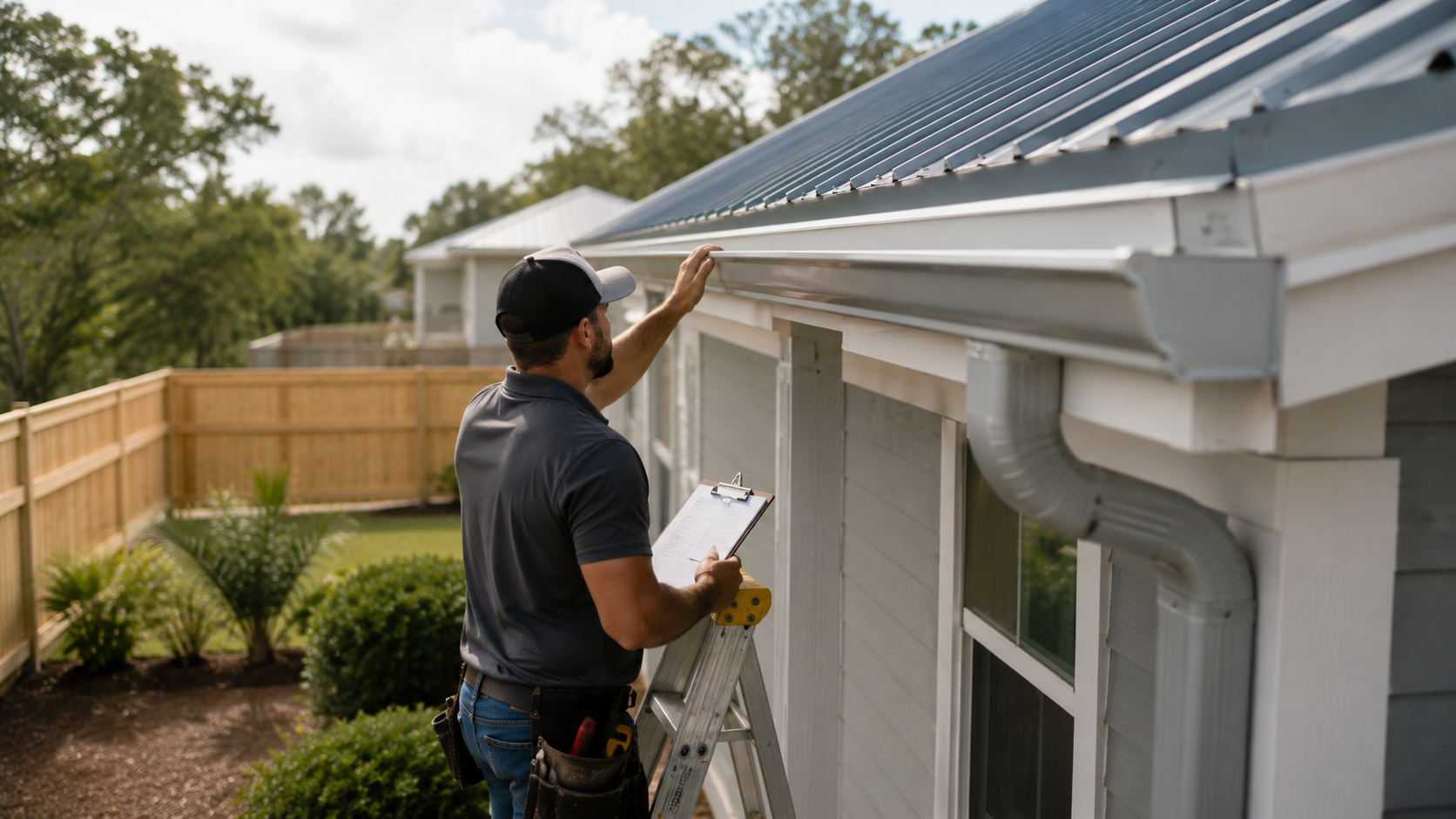
At Martin's Seamless Gutters & Fencing, the free estimate process starts there: not just what profile fits the fascia, but what volume the full system needs to handle under actual Gulf Coast storm conditions. That evaluation covers roof pitch, square footage, lot grading, and discharge options before a single measurement is taken.
What No Drainage System Can Fix
No drainage system corrects a grading problem.
That's worth knowing before spending money on the wrong fix. If a lot slopes toward the foundation, water will find the foundation regardless of what's hanging from the fascia. Gutters and downspouts manage roof runoff. They don't change site drainage. If water intrusion is appearing in a crawlspace and the gutters are functioning correctly, the problem is likely grade or subsurface water movement, not the gutter itself.
Rain chains specifically aren't a good fit for anyone who wants a low-maintenance, fully enclosed system. They need periodic cleaning, they clog in high-debris environments, and they require a proper termination point to function as anything beyond decoration. In areas with heavy tree canopy, that maintenance requirement compounds quickly.
Acting Now vs. Waiting: What the Decision Actually Costs
| Factor | With Martin's Seamless Gutters & Fencing | Waiting, DIY, or Unqualified Help |
|---|---|---|
| System sizing | Designed for peak Gulf Coast volumes, not average conditions | Often sized for typical weather; fails when it matters most |
| Discharge planning | Evaluated and addressed as part of every installation | Frequently skipped; pipe gets fixed, outlet doesn't |
| Materials | Top-grade from Spectra, Senox, ACM, Raytec, and Geocel | Variable; cost-driven substitution compounds problems over time |
| Warranty | Lifetime warranty on materials; extended warranty on new installations | None or limited; repair costs fall back on the homeowner |
| Foundation risk | Water reliably moved away from the structure | Ongoing risk with every rain event until root cause is resolved |
| Long-term cost | Upfront investment that protects against compounding repair costs | Lower initial outlay against a much larger, less predictable downstream cost |
The right time to address a drainage problem is before it shows up in your foundation. After that point, options narrow and costs grow.
Frequently Asked Questions
Can I add a rain chain to my existing gutter without replacing the whole system?
You can. Rain chains connect to the same outlet opening as a standard downspout, so the swap is straightforward mechanically. The real question is whether the existing gutter is correctly pitched and sized to feed the chain without overflow, and whether there's a catch basin or drainage outlet at the base. Without both of those in place, the chain functions as decoration rather than drainage.
How far should a downspout discharge from the foundation?
The general guidance is at least four to six feet, directed away from the structure. If your elbow terminates close to the house at grade level, or if you're seeing erosion, soil saturation, or discoloration near the foundation after rain, the discharge point is the problem. An extender or underground connection to a proper outlet is usually the solution worth pursuing.
What gutter size do most Pensacola-area homes need?
Most homes in our service area benefit from at least a 6-inch seamless gutter when the roof area draining to a single downspout is significant. Steeper pitches increase flow rate, which means both the gutter and the downspout need to match that increased volume. Our free estimate gives you a recommendation based on your specific roof geometry rather than a general rule of thumb.
Is buried drainage worth the added cost for a residential property?
It's worth it when surface drainage is visibly failing: pooling near the foundation, erosion at discharge points, or a lot that doesn't shed water naturally due to flat grading. If your lot has adequate slope and your downspouts discharge well away from the structure, subsurface drainage may not add meaningful protection. The value shows up most clearly when a surface problem is already present. Our drainage services page covers the available options in more detail.
Do rain chains work with leaf guards or gutter covers?
They can, but the outlet configuration matters. Some leaf guard systems restrict the outlet opening, which reduces flow to the chain and can cause overflow at the gutter before water ever reaches the base. If you're combining both, the outlet needs to pass the full flow rate without restriction.
How do I know whether my gutters need repair or full replacement?
Seamless aluminum gutters in good condition hold up well in this climate. The failure points are typically fasteners, downspout connections, and seams on sectional gutters rather than the gutter material itself. Seamless gutters eliminate most seam failures by design. If you're seeing sagging, separation from the fascia, or water running behind the gutter, a repair assessment will clarify whether you're looking at a targeted fix or whether the underlying structure has been compromised enough to warrant full replacement.
Is there any benefit to scheduling gutter and fence work at the same time?
If both projects are already on the list, combining them saves scheduling time and simplifies coordination. Martin's Seamless Gutters & Fencing handles both gutter installation and fence installation services, which means one estimate conversation, one project timeline, and one point of contact. For homeowners in Gulf Breeze, Pace, or Milton doing exterior upgrades, bundling both projects is a practical way to get them done without coordinating separate contractors.
Water coming off your roof isn't going to wait while you work through the decision. Contact Martin's Seamless Gutters & Fencing to schedule a free estimate and find out exactly what your property needs before the next storm makes the choice for you.
Martin's Seamless Gutters & Fencing is a family-operated company serving residential and commercial customers across Pensacola, Milton, Navarre, Gulf Breeze, Pace, Cantonment, and communities throughout Northwest Florida and Baldwin County, Alabama. Military, first responder, and senior citizen discounts are available. Lifetime warranty on materials.
About the Author
Patrick Martin is the owner of Martin's Seamless Gutters & Fencing, a family-operated business he founded in 2004. With more than 20 years of hands-on experience in seamless gutter systems, drainage solutions, and fencing installations, he specializes in water damage prevention and durable property protection built for Gulf Coast conditions. Martin's Seamless Gutters & Fencing serves 14-plus locations across Florida and Alabama with free estimates and top-grade materials from manufacturers including Spectra, Senox, ACM, Raytec, and Geocel.