How Gutter Installation in Florida Actually Works: Martin's Step-by-Step Methodology
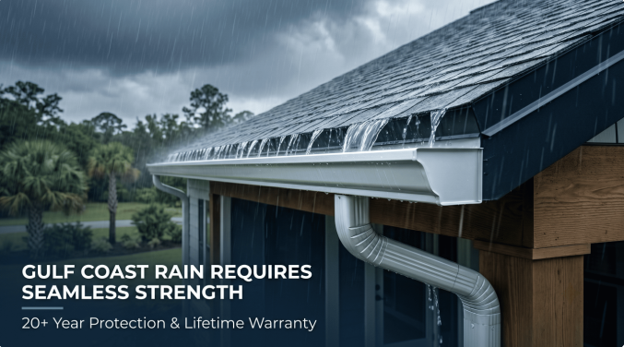
Water damage is the most expensive home repair most Gulf Coast homeowners never see coming. Until it's already inside the walls. Understanding exactly how professional gutter installation works in Florida's climate is the difference between a system that lasts 20 years and one that fails in the first storm season.
Direct Answer
Professional gutter installation in Florida follows a site-specific process: assess roof pitch and drainage load, determine gutter profile and material suited to Gulf Coast rainfall intensity, fabricate seamless sections on-site, install with correct pitch toward downspouts, and seal all joints. Done correctly, a seamless aluminum system handles Florida's high-volume rain events and resists corrosion for 20 or more years.
Key Takeaways
- Seamless gutters are fabricated on-site from a single coil of aluminum. Eliminating the seam joints where most gutter failures begin
- Florida's rainfall intensity, not just annual volume, determines the correct gutter width and downspout spacing for your property
- Improper pitch is the leading cause of standing water and premature gutter failure. Correct slope is 1/4 inch of drop per 10 feet of run
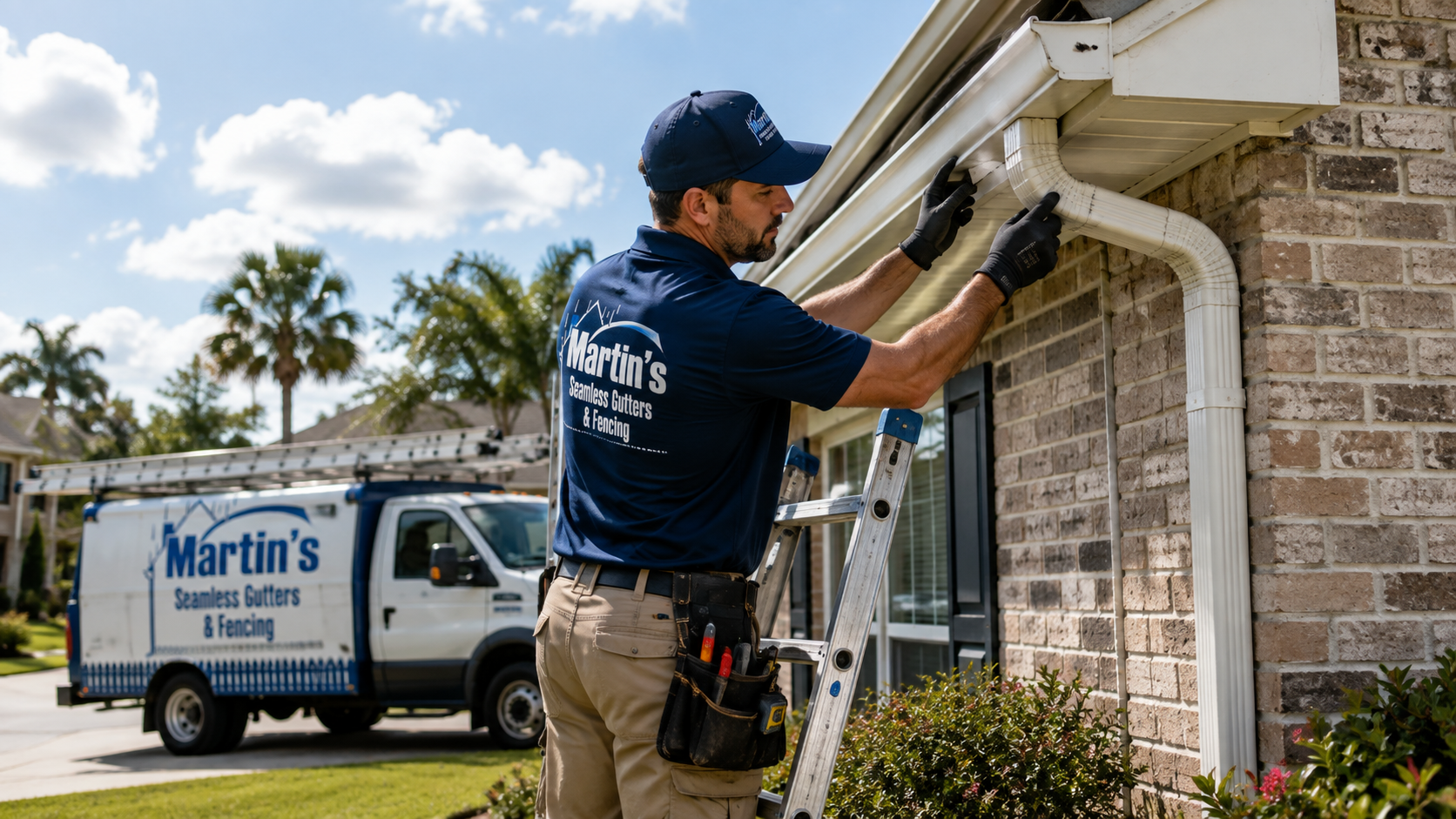
- Martin's Seamless Gutters & Fencing has served Northwest Florida and South Alabama since 2004, offering lifetime warranty-backed installation for residential and commercial properties
- Military, first responder, and senior citizen discounts are available. Ask when you schedule an appointment
Why Do Gutters Fail So Often in Florida?
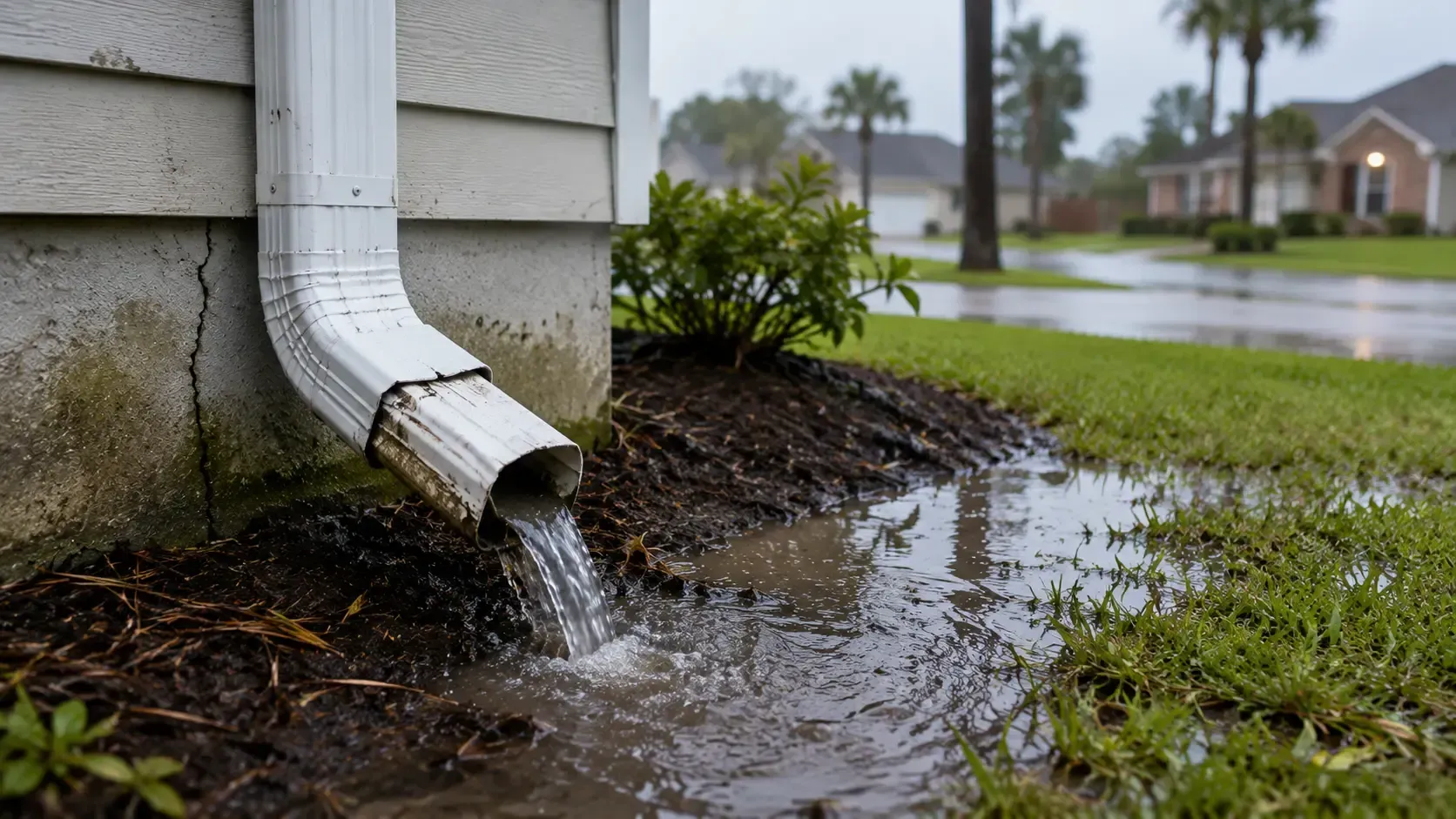
The surface symptom is familiar: gutters pulling away from the fascia, water spilling over the edge during a downpour, or standing water pooling against the foundation. Homeowners usually blame age or cheap materials.
The real problem is installation methodology that ignores Florida's specific rainfall conditions.
Florida receives some of the highest rainfall intensity in the continental United States. The National Oceanic and Atmospheric Administration (NOAA) documents that parts of the Florida Panhandle receive 60+ inches of annual rainfall, with intense short-duration storms that can deliver an inch of rain in under 30 minutes. Standard residential gutter sizing from northern climates is not engineered for that load.
A gutter system that works fine in Tennessee can be completely overwhelmed in Pensacola.
What's Actually Causing Gutters to Underperform. And Why Nobody Fixes It
The root cause is not material quality. It's specification error at the design stage. Choosing gutter size, downspout count, and placement based on general residential standards rather than local rainfall data.
Most gutter failures on the Gulf Coast trace back to one of three systemic errors:
- Undersized gutters- 4-inch K-style gutters installed where 5-inch or 6-inch profiles are required by drainage load
- Insufficient downspouts. Industry guidance calls for one downspout per 20-40 linear feet, but Florida's rainfall intensity often demands one per 20 feet or less
- Incorrect pitch. Gutters installed level instead of sloped, causing water to sit and accelerate corrosion from the inside out
The reason these errors persist is that they're invisible at the time of installation. A gutter installed flat looks identical to one installed with proper slope. The difference only appears during the first heavy storm. And by then, the contractor is gone.
This is why the methodology matters more than the material.
How Does the Actual Installation Process Work?
The Martin's Seamless Gutters & Fencing installation process follows what can be called the Gulf Coast Load Assessment Protocol. A site-specific evaluation sequence before a single piece of material is cut.
Gulf Coast Load Assessment Protocol is a pre-installation methodology that determines correct gutter sizing, downspout count, and placement based on roof surface area, pitch, and local rainfall intensity rather than generic residential defaults.
Here's how it works in practice:
Step 1: Roof Surface Drainage Calculation
The drainage area of each roof section is calculated. Not estimated. This accounts for roof pitch, which increases effective drainage area beyond the footprint of the house. A steeply pitched roof sheds water faster and in greater volume than a low-slope roof of identical square footage.
Step 2: Gutter Profile Selection
Based on drainage load, the correct profile is selected. For most Gulf Coast residential installations, 5-inch K-style aluminum is the baseline. Larger commercial or high-pitch residential applications often require 6-inch. Half-round profiles are available for historic or custom aesthetic applications but carry a higher price point.
Step 3: On-Site Seamless Fabrication
This is where seamless gutters differ fundamentally from sectional systems. A portable roll-forming machine fabricates continuous gutter runs from a single coil of aluminum. On the truck, at the job site, cut to the exact length needed. No joints. No seams. No future leak points.
Sectional gutters join at every 10-foot interval. Every joint is a potential failure point. In Florida's heat-expansion climate, those joints work loose over time. Seamless fabrication eliminates that failure mode entirely.
Step 4: Pitch and Hanger Installation
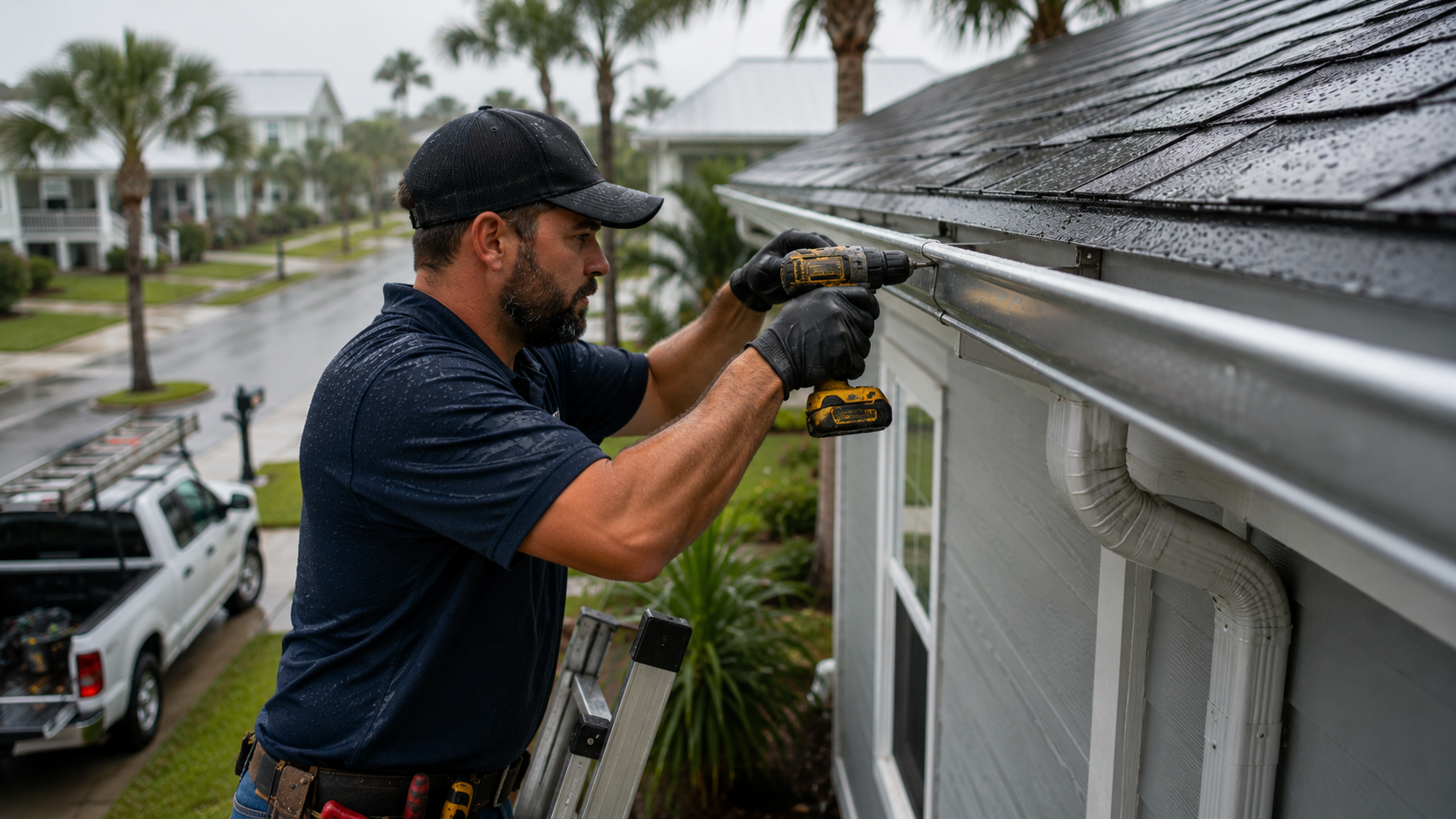
Gutters are hung with hidden hanger brackets spaced no more than 24 inches apart. Closer in high-wind zones. Pitch is set at 1/4 inch of drop per 10 feet of run toward the downspout. This is not a preference. It is the functional threshold below which water pools and above which water rushes past the downspout opening.
Step 5: Downspout Placement and Discharge
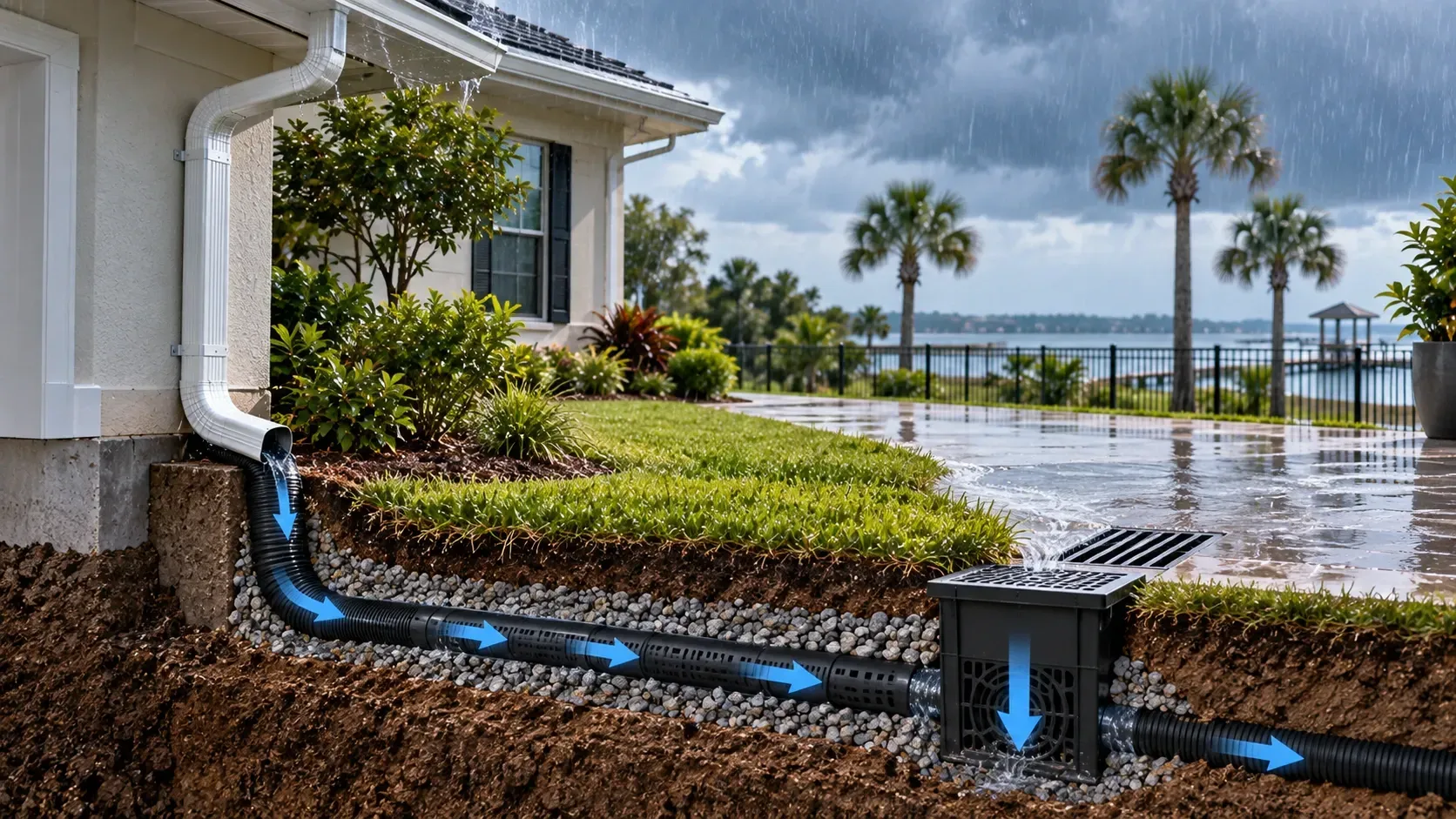
Downspouts are positioned to direct water away from the foundation, not just off the roof. Discharge must terminate at least 4 feet from the structure. Further where grading allows. Extensions and underground drainage connections are available for properties where surface discharge creates secondary problems.
Seamless vs. Sectional Gutters: What's the Real Tradeoff?
This comparison matters because sectional gutters are cheaper upfront and widely available at home improvement stores. Some homeowners install them as a DIY project. That is a legitimate choice. With real consequences worth understanding.
| Feature | Seamless Aluminum | Sectional Aluminum |
|---|---|---|
| Joint failure risk | None. Single continuous run | High. Joint every 10 feet |
| Lifespan (Gulf Coast) | 20-30 years properly maintained | 10-15 years before joint failure |
| Installation | Professional only (roll-forming machine required) | DIY possible |
| Upfront cost | Higher | Lower |
| Long-term cost | Lower (fewer repairs, longer replacement cycle) | Higher (recurring joint repairs) |
| Custom length | Yes. Cut to exact measurement | No. Cut from fixed sections |
| Warranty | Lifetime warranty available (Martin's) | Typically none or limited |
The contrarian claim here is worth stating plainly: choosing sectional gutters to save money upfront is often the more expensive decision over a 10-year window. Repair calls, joint resealing, and early replacement add up faster than the initial price difference suggests. Practitioners in the gutter industry consistently report that sectional gutter callbacks account for a disproportionate share of repair revenue. Not because the material is poor, but because the joint failure rate is predictable and inevitable.
What Does a Real Installation Scenario Look Like?
A commercial property manager in Pensacola managing a 12-unit residential complex had recurring water intrusion complaints from three ground-floor units. The existing sectional gutters were 15 years old, visibly sagging at the mid-span joints, and undersized at 4 inches for the roof drainage load.
Martin's Seamless Gutters & Fencing replaced the full perimeter, approximately 280 linear feet, with 5-inch seamless aluminum, added four additional downspouts to meet drainage load requirements, and extended all discharge points 6 feet from the foundation. The water intrusion complaints stopped after the first storm season. Total replacement cycle: one day of installation. No callbacks in the following 18 months.
That outcome isn't remarkable. It's what correct specification and installation produce.
Who Is This Approach Not Right For?
Honest answer: not every property needs seamless aluminum.
If you own a small outbuilding, a detached garage, or a structure where aesthetics are irrelevant and budget is the only constraint, sectional vinyl gutters may be sufficient. They won't last as long, but the cost-to-lifespan ratio can make sense in low-stakes applications.
Seamless aluminum installation is not a DIY project. The roll-forming machine that fabricates seamless gutters costs tens of thousands of dollars and requires trained operation. Any contractor offering "seamless gutters" without on-site fabrication equipment is selling sectional gutters under a misleading label. Ask to see the machine.
Martin's Seamless Gutters & Fencing also does not promise that gutters alone solve all drainage problems. If a property has grading issues, cracked foundation drainage, or compromised fascia boards, gutters address the roof runoff component. Not the underlying site drainage condition. Those issues require separate evaluation.
Frequently Asked Questions
How long does gutter installation actually take for a typical house?
For most single-family homes, a full seamless gutter installation takes one day or less. A crew arrives with the roll-forming machine, fabricates sections on-site, and installs the complete system in a single visit. Larger commercial properties or complex rooflines may require two days.
What size gutters do I need for my Florida home?
Most Gulf Coast homes require 5-inch K-style gutters as a minimum. Not 4-inch, which is standard in lower-rainfall regions. Homes with steep roof pitches, large drainage areas, or frequent heavy storm exposure should be evaluated for 6-inch gutters. The correct size depends on your specific roof surface area and pitch, not a general rule.
How do I know if my current gutters are the wrong size?
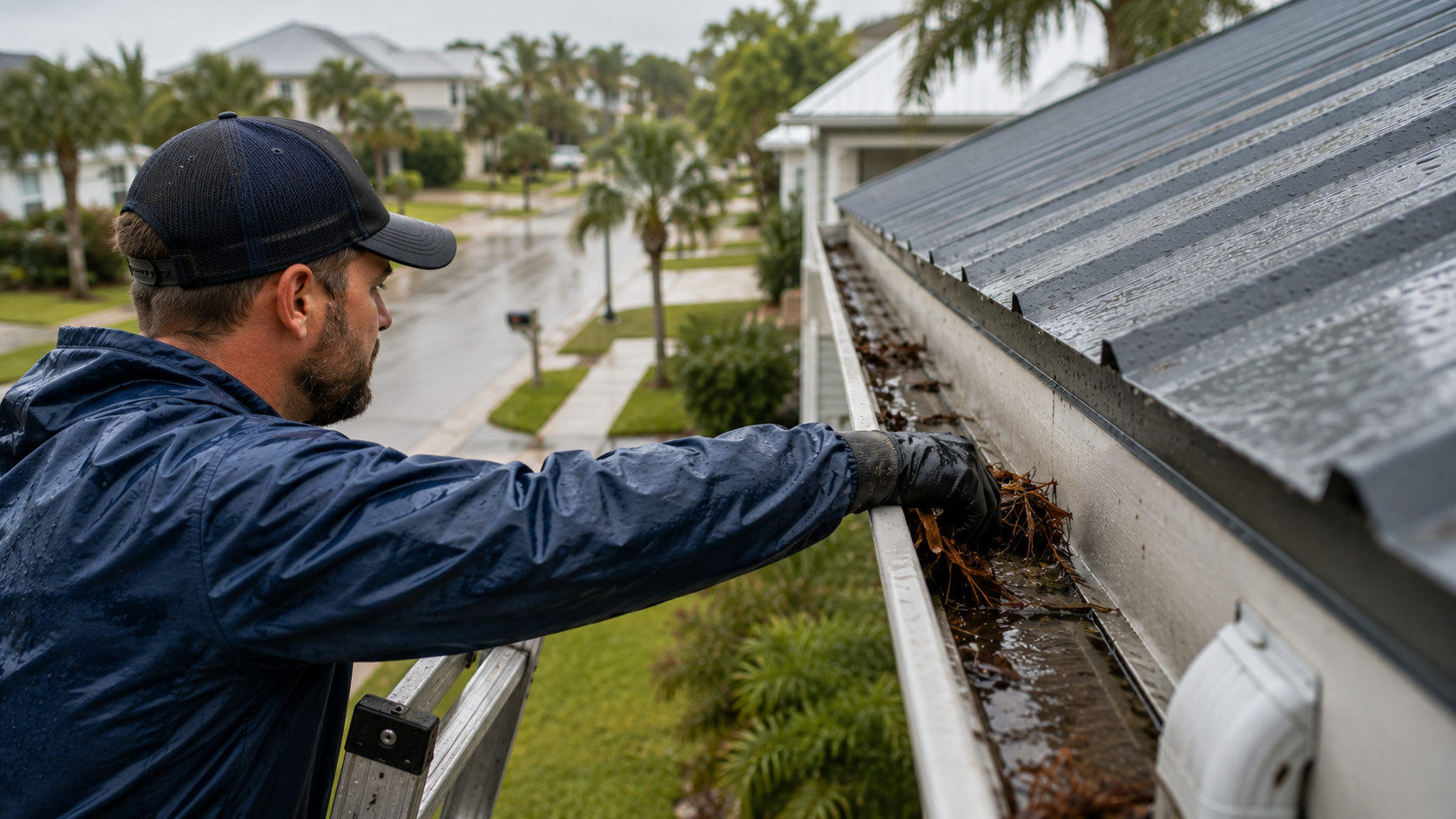
If water spills over the front edge of your gutters during a moderate rainstorm, not a hurricane, just a typical Florida afternoon storm, your gutters are undersized or improperly pitched. Overflow at the front lip indicates the gutter cannot accept water fast enough. Overflow at the ends indicates pitch or downspout problems.
What's the difference between seamless gutters and regular gutters?
Seamless gutters are fabricated from a single continuous piece of aluminum cut to the exact length of each roof run, with no joints along the span. Regular sectional gutters are pre-cut in 10-foot pieces and joined together on-site. Joints are where leaks, sagging, and failures originate. Seamless systems eliminate that failure point entirely.
Does Martin's Seamless Gutters & Fencing serve areas outside Pensacola?
Yes. Martin's Seamless Gutters & Fencing serves 14-plus locations across Northwest Florida and South Alabama, including the broader Gulf Coast region. Residential and commercial clients throughout the Panhandle can schedule an appointment for installation, repair, or a site assessment.
How much does seamless gutter installation cost compared to sectional?
Seamless aluminum installation costs more upfront. Typically 10 to 30 percent more than sectional depending on profile and linear footage. Over a 10-to-15-year period, most homeowners find the total cost of ownership is lower because seamless systems require fewer repairs and have a longer replacement cycle. Get a specific quote based on your property's measurements.
What warranty does Martin's offer on gutter installation?
Martin's Seamless Gutters & Fencing backs installations with a lifetime warranty on materials and workmanship. That warranty reflects confidence in the installation methodology. A system installed correctly to Gulf Coast specifications should not fail prematurely. Ask about specific warranty terms when you schedule your appointment.
The one thing worth remembering from all of this: a gutter system is not a commodity purchase. It is a water management decision, and the Gulf Coast does not forgive undersized or incorrectly installed systems.
If you've read this far, you already know what most homeowners don't find out until they're dealing with water damage: the installation methodology matters more than the material brand. Martin's Seamless Gutters & Fencing has been doing this work across Northwest Florida and South Alabama since 2004. If your gutters are failing, undersized, or simply aging out, call Martin's and schedule a site assessment. Not a sales call, an actual evaluation of what your property needs.
References
- National Oceanic and Atmospheric Administration (NOAA). Precipitation frequency data and annual rainfall documentation for the Florida Panhandle and Gulf Coast region.